


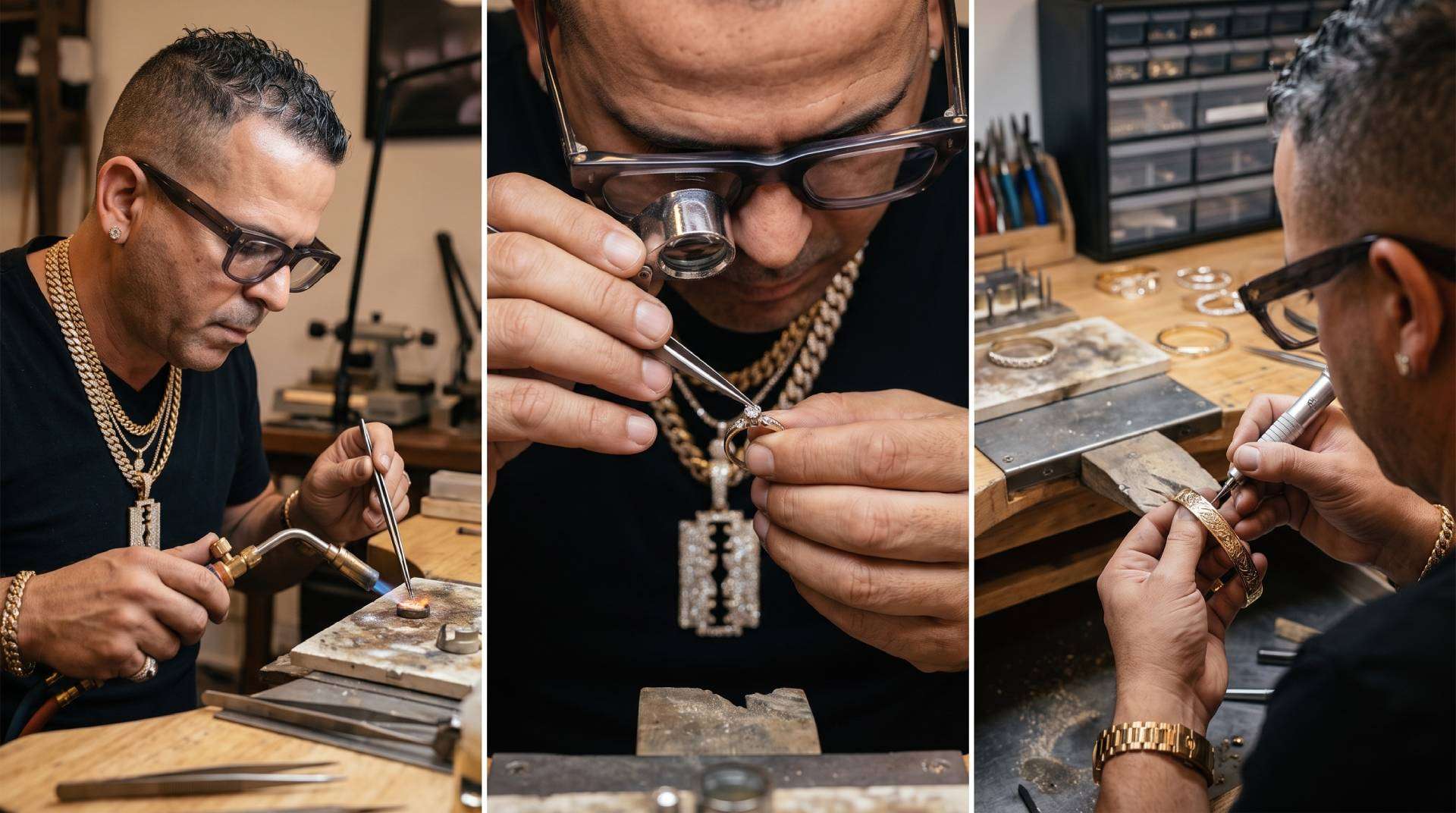
We live in a culture consumed by the disposable. Digital experiences evaporate as fast as they appear, and industrial mass production has trained the modern consumer to accept hollow, short-lived objects engineered to lose their appeal within a season. Standing against this tide of planned obsolescence is high-end jewelry—one of the last unapologetic frontiers where time is not saved, but deliberately accumulated.
To measure exceptional jewelry strictly by the daily spot price of gold or the carat weight of a stone is an act of cultural shortsightedness. Noble metals and gemstones are merely raw canvas. The true substance of an extraordinary piece does not live in its elemental chemistry; it lives in the friction between raw matter and the artisan’s hand. As documented across the decorative arts collections of the Metropolitan Museum of Art, precious metalwork has always paralleled sculpture and architecture. High-end jewelry is fine art because it demands the very disciplines that have defined masterworks for centuries: relentless technical command, monastic patience, and the rare ability to translate human emotion into a physical object built to outlast its maker. In essence, high-end jewelry epitomizes FINE ART.
Sculpture in Miniature: Fire, Tension, and the Master’s Touch
In classical academia, sculpture belongs to towering marble or bronze cast on a monumental scale. The master jeweler, however, sculpts in fractions of a millimeter, where a single miscalculated stroke ruins weeks of labor. Smelting pure bullion, formulating precise 14k or 18k alloys, drawing solid wire through gauge plates, and manipulating every link to rest flat against human skin is pure sculptural engineering.
Consider an authentic handmade Cuban link chain. To the casual eye, the finished silhouette appears deceptively fluid—a continuous ribbon of dense gold draping effortlessly along the collarbone. What the surface hides are dozens of hours over the torch, the piercing saw hand-cutting every interlock, the careful filing required to align flat geometric facets that command light, and the hand-machined box clasp that seals with the heavy, reassuring click of a bank vault. No algorithmic casting machine can replicate the tactile intuition of an experienced bench jeweler who gauges metal density and structural integrity through the simple vibration of a hand file. Mass production repeats; the true artisan interprets.
Kinetic Art: Micro-Engineering on the Wrist
This artistic philosophy does not end at traditional goldsmithing. It finds its exact twin in the world of mechanical horology, where sculpture ceases to be static and becomes an intricate kinetic machine.
According to the horological standards curated by the Fondation Haute Horlogerie, decorative techniques such as anglage (hand-chamfering), Côtes de Genève, and perlage represent an unbroken lineage of artisanal crafts. When an experienced watchmaker mirror-polishes a balance bridge screw smaller than a grain of sand or regulates an escapement to resist the pull of gravity, they are executing an act of deliberate creative expression.
A certified pre-owned luxury timepiece is kinetic sculpture preserved inside surgical steel or solid gold. In an era where disposable quartz crystals or connected screens register time with indifferent precision, wearing an authenticated mechanical watch is an intentional choice: you are carrying a miniature mechanical heart that beats purely through human kinetic movement and mainspring tension.
Wearable Memory: The Anthropological Artifact
Art has always carried an anthropological duty: to preserve who we were, what we built, and the milestones we achieved. A canvas hangs quietly on a wall and a manuscript sits on a bookshelf, but high jewelry is lived in. It is an intimate sculpture that walks into boardrooms, shares celebratory dinners, and withstands the physical friction of daily life.
As natural materials classified under rigorous criteria by the Gemological Institute of America (GIA), fine gems and solid metals are chemically inert, meaning they endure unchanged across centuries. Over decades, an authentic piece gathers the unique patina of its wearer’s journey. It survives economic cycles, shifting fashion trends, and family transitions, passing from one generation to the next without suffering structural decay. Long after consumer technology is forgotten in desk drawers and bespoke tailoring has worn thin, solid precious metal remains sovereign. It is a tangible heirloom ready to be strapped on or worn around the neck fifty years later with the exact same weight and pride.
The Enduring Dignity of the Workbench
Modern luxury often confuses itself with loud branding, disposable hype, and printed logos. Genuine luxury—the kind that belongs firmly within the realm of the fine arts—never has to scream. It announces itself through the dense heft of solid metal in the palm of your hand, the balance of its proportions, the clean security of its setting, and the certainty that no hidden edge was neglected.
Inside a working atelier, where the torch flame cuts the room and the heat of worked metal hangs in the air, jewelry is never treated as an inventory commodity. It is an enduring dialogue between nature’s rarest elements and human dedication. It proves that even in the twenty-first century, discerning collectors will always seek what is real, permanent, and shaped by the soul of human hands.